Xi'an News Network, Beijing, September 30 Title: Pet Industry Development Shows Four Major Trends
Xinhuanet reporter Li Nan Li Ya
In recent years, the global pet industry has entered a fast growth track, and has grown into a large industry with considerable scale and diverse business models.
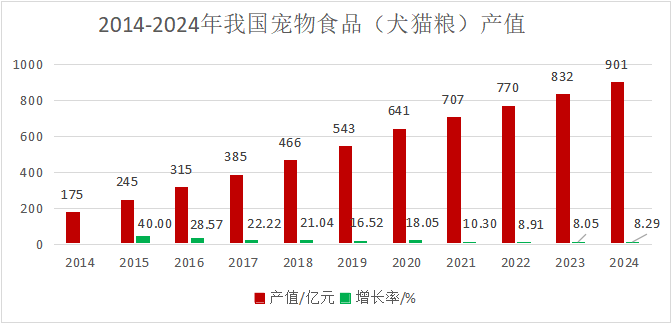
Analysis chart of the output value of pet food (dog and cat food) in China from 2014 to 2024 (Provided by the Pet Nutrition Team of the Institute of Animal Husbandry, Chinese Academy of Agricultural Sciences)
The data statistics of the Pet Nutrition Team at the Institute of Animal Husbandry of the Chinese Academy of Agricultural Sciences show that in 2024, the number of pet dogs and cats in China reached 140 million, and the total scale of the pet industry exceeded 300 billion yuan, with the pet food market accounting for ***. By 2024, the market size of dog and cat food for pets reached 90 billion yuan, an increase of 8.3% over 2023.
The data from the China Animal Feed Industry Association shows that the national pet feed (main food) output reached 16 million tons in 2024, a 66.7% increase from five years ago, and has maintained double-digit growth for many years. In the first seven months of 2025, the output reached 10.06 million tons, a year-on-year increase of 14.5%.
Experts point out that China's pet industry, though it started late, has developed rapidly, achieving a major transformation from OEM/ODM to independent innovation. Currently, the pet industry is showing many new trends, such as the pet food industry becoming branded, pet supplies becoming intelligent, the development of the industry becoming clusterized, and the acceleration of independent brands towards internationalization.
Pet food branding
Pet industry, divided into the primary, secondary, and tertiary industries according to tradition. The primary industry covers pet production, breeding, and sales; the secondary industry involves the manufacture of pet supplies, food, medicine, and related instruments and equipment; the tertiary industry includes pet diagnosis, beauty and other service fields.
The pet food industry, as the core of the industrial chain, has seen its market size continue to expand in recent years. The association president of China Feed Industry Association, Wang Zongli, analyzed that during the "6·18" period of Tmall in 2025, the sales of pet food reached 7.5 billion yuan, a year-on-year increase of 36%, and the growth rate of emerging categories exceeded 40%.
With the development of the pet industry, domestic pet food brands are becoming increasingly diverse. (The image was generated by the AI assistant of Xinhua News Agency for photography and editing)
Wang Zongli believes that the pet industry chain has a prominent driving effect, and has become a force to expand domestic demand, promote consumption upgrading, and empower the real economy. Its upstream is connected to agricultural raw materials, the midstream has online and offline brand sales networks, and the downstream has derived services such as medical beauty.
Liu Lang, vice president of the Chinese Association of Veterinary Medicine, believes that the pet industry has also become a new engine for creating employment. In addition to the traditional veterinary profession, emerging professions such as pet groomers are constantly emerging, opening up new paths for the employment market.
In the early days, China's pet food industry often played the role of a "contract manufacturer" for foreign brands, located at the low end of the industry chain, with a lack of independent brands and weak core competitiveness. However, with the rise of the domestic pet economy, many leading enterprises have emerged today. They are aggressive and innovative, actively entering the mid-to-high-end market.
Pet food domestic brands are accelerating their rise. Wang Zongli introduced that among the top ten online pet food sales in 2024, domestic brands occupy five seats (Mai Fudi, Lan Shi, NetEase Yanxiang, Xianlang, Weisheng). Six domestic companies, such as Qiaobao Pet and Zhong Pet Shares, have successfully listed, and their brand competitiveness and market recognition have significantly improved.
Pet food, as the core sector of more than half of the pet economy, is self-evident in its importance. Liu Lang said that the monopoly pattern of foreign brands has been broken, and domestic enterprises are firmly investing in R&D, improving quality, and strengthening brands, injecting strong impetus into the development of the pet industry.
Pet supplies intelligence;
Technology has not only reshaped the interaction patterns between humans and pets, but has also built a brand new feeding ecology, bringing unprecedented smart life experience to our "four-legged family members".
In the app screen, the amount of food eaten by the cat and the nutritional intake data are updated in real time, and the dynamic feeding suggestions are generated precisely according to its age, weight, and activity level... Nowadays, the daily care of "four-legged children" is becoming increasingly intelligent.
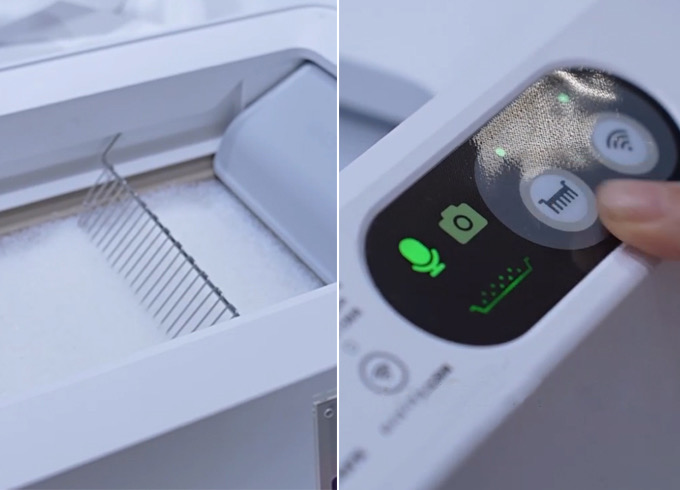
The 27th Asian Pet Show, held in Shanghai from August 20th to 24th, showcased a smart cat litter box device by a participating company.
From August 20th to 24th, the 27th Asian Pet Show was held in Shanghai. At the exhibition, a smart cat litter box showcased by a certain company became the focus. When the cat moves away from the box, the camera captures the toileting behavior and triggers the automatic cleaning. Major companies have successively unveiled new products such as smart feeding devices, AI monitoring systems, and functional nutritional food, fully displaying the industry's innovative vitality.
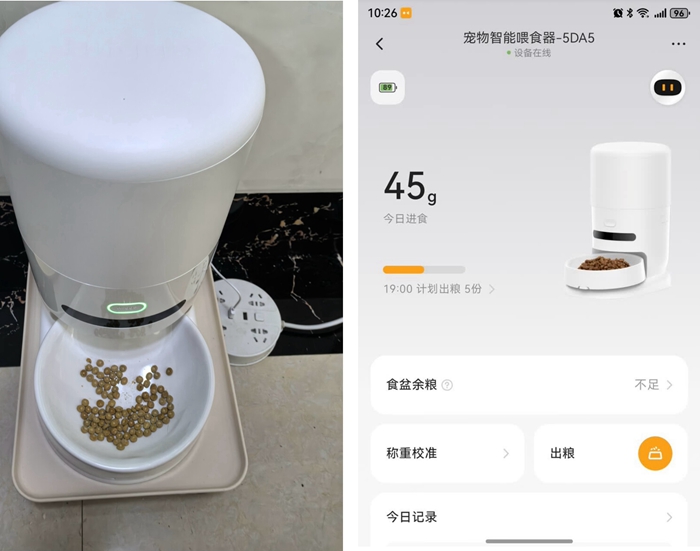
Ms. Huang from Chengdu, Sichuan Province, controls the smart feeder remotely through a mobile app screenshot.
In Chengdu, Sichuan, Ms. Huang uses a mobile app to remotely control a smart feeder, precisely feeding her pet cat with customized fresh food, setting an example of technological pet care.
Wang Zongli pointed out that with the dual drive of technology and industrial upgrading, innovative products such as smart feeding devices, pet insurance, and health management apps are emerging like bamboo shoots after a rain, driving pet products to gradually upgrade towards high added value.
Science and technology have given the pet industry a pair of wings to take off. As Wang Jinquan, chief scientist of the pet nutrition and food innovation team at the Institute of Animal Science of the Chinese Academy of Agricultural Sciences, said, today, the forms of pet supplies are constantly upgrading, and consumer demand is also shifting from "basic feeding" to "emotional companionship" and "precision nutrition".
Wang Fengzhong from the Institute of Food and Nutrition Development under the Ministry of Agriculture and Rural Affairs said that technology is injecting strong power into the pet industry. China's pet enterprises and institutions should take precision medicine and the research and development of functional food as a breakthrough to promote the multi-dimensional development of the industry.
Industrial development clusterization
The pet industry park plays a key role in the process of the agglomeration and upgrading of China's pet industry, and injects strong power into the sustainable growth of the pet economy. In recent years, some local governments have actively participated in the planning and construction of regional pet industry parks.
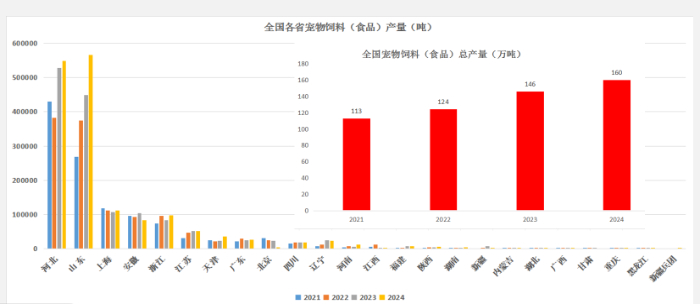
The pet nutrition team of the Feed Research Institute of the Chinese Academy of Agricultural Sciences has analyzed the production of various pet feed (food) across the country from 2021 to 2024 (Pet Nutrition Team of the Feed Research Institute of the Chinese Academy of Agricultural Sciences).
According to the China Feed Industry Association***, the output of pet food in Shandong Province reached 5.66 million tons in 2024, surpassing Hebei Province, and the Northeast region is also showing emerging development trends. Wang Zongli stated that the pet industry cluster effect is significant, and it has achieved cluster development relying on advantages such as raw materials and location. The output of Shandong and Hebei accounts for nearly 70% of the country, while the Yangtze River Delta accounts for 21%.
At present, 22 key pet industry parks have been built in the whole country, such as Hengshui Pet Town in Hebei and Pet Industrial Park in Yantai, Shandong. In terms of the national distribution of pet industry parks, Linyi, Shandong and Xingtai, Hebei have become the core development areas. Emerging areas such as Pinggu District in Beijing and Luohu District in Shenzhen are also accelerating their layout.
Reporters learned that Luohu in Shenzhen is planning to build a pet economy industrial park covering an area of 75,000 square meters, which has successfully attracted 182 pet enterprises to settle in. In order to promote the rapid development of the industry, the local government has also introduced special support policies.
The local government has actively introduced policies to promote the innovation and green development of the pet industry in the park. Zhao Jinghui, deputy general manager of Jiangsu Jinhuang Investment Development Group Co., Ltd., told reporters that Jiangsu Guannan County has relied on its geographical and resource advantages to focus on building a full-industry chain park for pet food. At present, the park has attracted many pet enterprises, forming an industrial cluster effect.
Liaoning's Anshan is an important breeding base for pets in China. Han Wei, deputy director of the Anshan Municipal Department of Agriculture and Rural Affairs, said that Anshan supplies more than 1.5 million dogs and cats to the country every year. In addition, the standardization of pet trading is steadily advancing. The first draft of the relevant group standard formulated by the Anshan Municipal Pet Chamber of Commerce has been completed and is being reviewed intensively. It is expected to be released later this year.
Wang Fengzhong believes that at present, pet industry parks in various places have formed a full industry chain covering research and development, production, testing, sales and other links. From a single production to a comprehensive integration of "research and development - manufacturing - market", the efficiency of the industry has been improved.
Domestic brand internationalization
Driven by the wave of globalization, the pace of China's pet industry going global is accelerating, and its brands are becoming increasingly international.
Over the past decade, China's dog and cat food import and export trade has shown a solid growth trend, with exports playing a dominant role, said Wang Jinquan. This is thanks to the continuous expansion of the international pet food market and the steady improvement of China's pet food production capacity and quality.
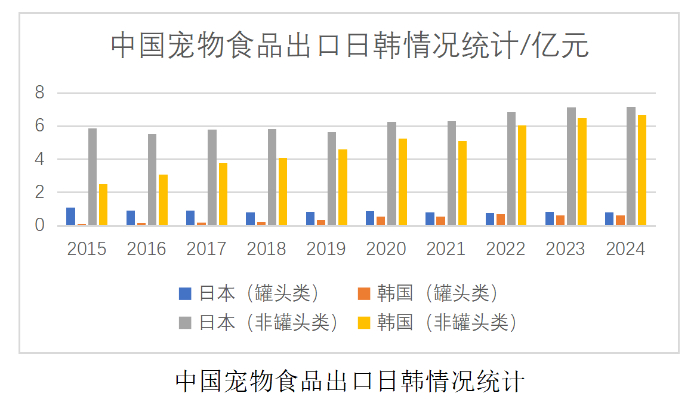
Statistics on the export of pet food from China to Japan and South Korea (compiled by the Pet Nutrition Team of the Institute of Animal Science, Chinese Academy of Agricultural Sciences, based on public data from the General Administration of Customs)
Wang Jinquan's analysis suggests that Japan and South Korea are important export destinations for China's pet food industry, accounting for 12% of total exports in 2022. Chinese brands have entered the Japanese market with cost-effective and differentiated products, and the export value of non-canonical products to South Korea has doubled since 2015.
However, the path to overseas for Chinese pet brands is not smooth. Wang Jinqian analyzed that in the Australian market, consumers have a preference for high-end and healthy pet food, and the market size of fresh food continues to expand. If the quality or differentiation of pet products is insufficient, the penetration will be limited.
Despite challenges, many companies have still achieved impressive results. In 2024, Wanpy, the independent brand of Zhong Pet Shares, saw a continuous increase in orders in Southeast Asia, Eastern Europe, the Middle East, Latin America, and Africa. That year, Zhong Pet Shares' revenue reached 4.465 billion yuan, with overseas income accounting for 68.33%; in the first half of 2025, revenue was 2.432 billion yuan, a year-on-year increase of 24.32%.
The chief marketing officer of Xiao Pei Network Technology (Shanghai) Co., Ltd., Wei Wei, introduced that the company focuses on smart cat litter boxes and other pet products, precisely adapting to the needs of local markets around the world, and has made significant efforts to lay out global patents, already owning more than 200 patents. Its AI technology products have performed exceptionally well, and are now selling well in more than 180 countries and regions around the world, with a user base of over 5 million.
For the international development of China's pet brands, Chen Xiaowei, the president of the Fujian Province Pet Service Industry Association, believes that if Chinese pet brands are to achieve a transformational development from "made for export" to "branded for export", they need to focus on the advantages of the supply chain and continuously improve product innovation and brand value.
Multi-dimensional efforts to support high-quality industrial development
At present, the pet industry is booming while facing many challenges. Some companies focus on middle and low-end products, with a lack of core technology R&D investment, relying on imports, a shortage of professional talents, serious product homogeneity, and bad online information also disrupts the market and hinders industrial upgrading.
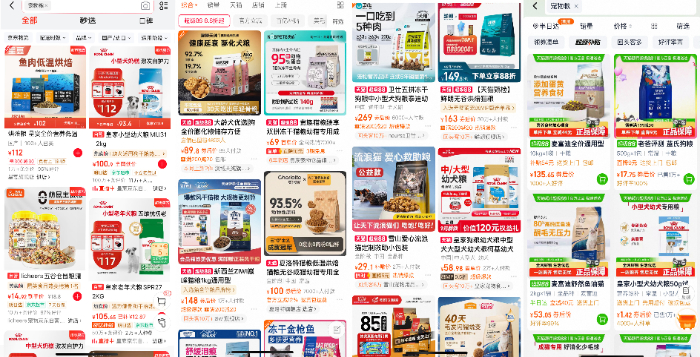
Part of the e-commerce platform screenshot (collected by Xinhua News Agency)
Consumers have reported that they need to be as meticulous as researchers to study the ingredient list, inspection reports, and prices to avoid " Setting off a landmine" when choosing pet food. On some e-commerce platforms, pet food advertisements are everywhere, with slogans such as "High protein 42%", "Freeze-drying to lock freshness", and so on, which are dazzling and difficult to choose.
Chen Xiaowei reminds that for pet products, one needs to remain rational when making purchases, not blindly trust the publicity of internet celebrities or KOLs, and be wary of "fake experts". It is advisable to choose brands with clear standards, certifications, and traceability, focusing on mid- to high-end products.
Cao Lingxiang, a partner at Beijing Zhongyin Law Firm, advised consumers to understand relevant laws and regulations, choose enterprises with proper qualifications and guaranteed product quality, not easily believe advertisements, enhance their awareness of safeguarding their rights, keep and fix consumption evidence, and protect their own rights through complaints to relevant government departments and court litigation.
Chen Xiaowei proposed that pet industry enterprises should formulate enterprise standards that are stricter than national and industry standards, disclose formula nutritional indicators, and introduce third-party traceability. Medium and large-sized enterprises should take the road of standardized branding.
In terms of pet food early warning monitoring and standard setting, Wang Jinquan said that key monitoring of pet feed raw materials and all types of products has been carried out, safety indicators have been strictly inspected, and a number of industry standards have been promoted to establish, and mandatory national standards are being organized to formulate, standardizing raw materials, quality control, safety testing and traceability.
Promoting harmonious coexistence between humans and pets and green development is the core of the sustainable development of the pet industry," Wang Zongli said. In the future, a tripartite coordination mechanism among the government, enterprises, and consumers is needed to pool efforts and push China's pet market to advance from scale expansion to high quality.